
Why Nonviolent Resistance Doesn't Require Your Opponent to Have a Conscience
If nonviolence required tyrants to grow a heart, we'd be finished—violence is what they're begging for. History shows we beat them by withdrawing pillars of support until they're forced to concede.

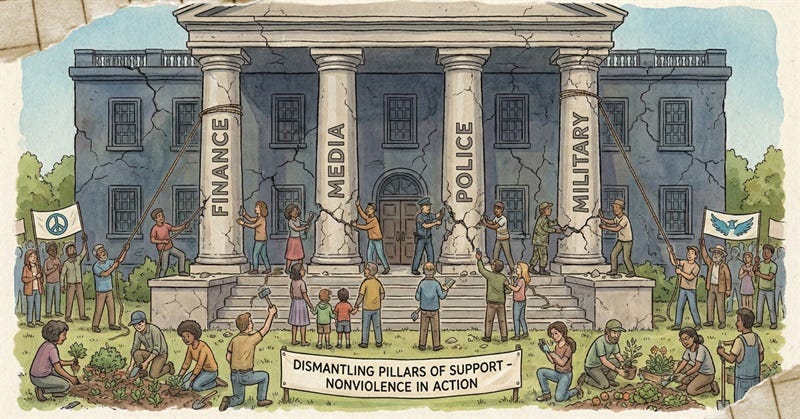
One objection comes up often when discussing nonviolent resistance.
“That only works if your opponents have a conscience. Trump and his allies have shown they have none.”
It’s true - they revel in cruelty. But fortunately, this rests on a fundamental misconception about how this strategy actually works.
The truth is more encouraging: nonviolent resistance has never depended on touching the hearts of tyrants. It succeeds by making tyranny unsustainable.
What History Actually Shows Us
Consider the American Civil Rights Movement. Bull Connor didn’t suddenly grow a conscience when he unleashed fire hoses and dogs on peaceful protesters in Birmingham, nor did Sheriff Jim Clark have an epiphany about human dignity as he brutalized marchers on the Edmund Pettus Bridge.
What changed was the political and economic cost of segregation. Images of state violence shocked moderate whites, energized federal intervention, and hit businesses with boycotts while cities grappled with disruption—making racism too expensive to sustain. The movement won not by converting segregationists, but by withdrawing the consent and resources they needed to rule.
The same pattern holds internationally.
The South African apartheid regime didn’t negotiate with Nelson Mandela and the ANC because the National Party leadership suddenly felt guilty about decades of white supremacist violence. They negotiated because international sanctions, internal resistance, economic isolation, and the defection of key business interests made apartheid ungovernable. By the time they came to the table, maintaining the system cost more than reforming it.
The Solidarity movement in Poland didn’t overcome Communist Party hardliners through moral persuasion. They organized enough of Polish society - workers, intellectuals, church networks - that the regime could no longer function effectively. When millions of people simply stopped cooperating with the system, it collapsed under its own weight.
The Philippine People Power Revolution didn’t succeed because Ferdinand Marcos developed a conscience. It succeeded because mass mobilization, defections within the military, withdrawal of US support, and nationwide strikes made his continued rule impossible to maintain.
Notice the pattern: In each case, victory came through making oppression unsustainable, not through changing oppressors’ hearts.
The Mechanics of How Nonviolent Resistance Actually Works
Strategic nonviolent resistance operates through several mechanisms that function independently of the opponent’s moral character:
1. Economic Disruption
Strikes, boycotts, and work stoppages create financial pressure that operates regardless of anyone’s feelings. When Montgomery’s Black community boycotted segregated buses for 381 days, the bus company suffered severe financial losses and warned of imminent bankruptcy; desegregation followed a federal court ruling under boycott pressure.
When workers strike, production stops. When consumers boycott, profits fall. When communities practice economic non-cooperation, local economies seize up. These are mechanical consequences, not moral ones. A regime can be utterly amoral and still feel the pain of economic collapse.
The genius of this approach is that it converts moral force into material pressure. You don’t need to change hearts when you can change balance sheets.
2. Defection of Regime Pillars
Every authoritarian system depends on what scholar Gene Sharp called “pillars of support” - the institutions and individuals who actually implement the regime’s will. Police officers who enforce orders. Bureaucrats who process paperwork. Corporations that provide logistical support. Religious institutions that provide moral legitimacy. Military personnel who follow commands.
Nonviolent resistance works by peeling away these pillars one by one.
When police are asked to brutalize peaceful protesters, some refuse. When bureaucrats are ordered to implement unjust policies, some resign. When business leaders see the writing on the wall, some withdraw cooperation. When judges face national scrutiny, some find their spine. When soldiers are commanded to fire on their own people, some defect.
This isn’t about appealing to conscience (though that sometimes helps). It’s about creating situations where cooperation with injustice becomes more costly than defection. When a critical mass of these pillars begin to crack, the whole structure becomes unstable.
During the Serbian resistance to Slobodan Milošević—which endured beatings, arrests, and killings of activists—Otpor made police defection a strategic priority. Rather than treating officers as enemies, activists showed them respect, distributed leaflets to police families framing them as fellow citizens who would have to live with crackdown consequences, and challenged the regime’s “terrorists” label—which clashed with the reality of the young protesters they encountered. As the movement grew, Otpor’s rapid response teams documented and publicized beatings with lawyers and media, further eroding legitimacy. On October 5, 2000, when hundreds of thousands marched into Belgrade, leaders stayed in touch with special police units; most refused orders to attack, the central police station surrendered with dozens injured but no shots fired, and Milošević fell—not from a change of heart, but because those who would have defended him chose not to.
3. Backfire Effects & Institutional Pressure
Nonviolent campaigns create what political scientists call “backfire effects” - when violent repression of peaceful protest generates sympathy and support from third parties who might otherwise remain neutral.
Bull Connor’s dogs and fire hoses didn’t just shock the nation’s conscience - they created a political crisis for the Kennedy administration that forced federal intervention. The violence against peaceful protesters made neutrality untenable for moderate institutions.
International observers, allied governments, religious institutions, business interests, and domestic political actors who prefer stability all face pressure to intervene when violence against nonviolent protesters becomes visible and sustained. This isn’t primarily about their moral sensibilities - it’s about the political costs of being associated with brutal repression.
In the fight against South African apartheid, activists didn’t win by appealing to corporate conscience; they made complicity costly in very practical ways. In New York City in 1965, SNCC, SDS, and CORE organized sit‑ins at Chase Manhattan’s headquarters, explicitly targeting the bank’s loans to South Africa and forcing its role in bankrolling apartheid into public view. Later, SNCC organizers even occupied the South African consulate in New York, tying Wall Street finance, U.S. racism, and apartheid together in a single campaign.
On campuses, students turned their outrage into daily operational headaches. At Columbia in 1985, roughly 300 students blockaded Hamilton Hall for weeks, disrupting normal university business until the trustees agreed to partial divestment from companies operating in South Africa. At UC Berkeley and other universities, students built shantytown encampments, held constant rallies and teach‑ins, and defied new rules meant to shut them down, making it harder and harder for administrators to justify South Africa‑linked investments to faculty, alumni, and the press.
Meanwhile, churches and religious denominations became active participants in the divestment campaign. The World Council of Churches called for comprehensive economic sanctions against South Africa. The Presbyterian Church USA divested in 1984. The United Methodist Church followed in 1986 after pressure from its black caucus pushed leadership beyond passive statements toward direct action. Unions and activist shareholders filed resolutions and proxy fights that forced companies to defend their South Africa ties in annual meetings, and local governments passed divestment ordinances that threatened real contracts and capital—like Baltimore’s 1986 ordinance covering $1.1 billion in city pension funds.
Under that combined pressure - campus occupations, church divestment, bank protests, shareholder resolutions, and municipal action - maintaining investments in apartheid South Africa stopped being a neutral choice and became a reputational, legal, and financial liability that boards and executives increasingly decided just wasn’t worth it.
4. Mass Non-Cooperation Making Systems Ungovernable
This is perhaps the most powerful mechanism, and the least understood. At a certain threshold, when enough people simply refuse to cooperate with a system, it ceases to function regardless of what leaders want.
The system depends on compliance. When workers don’t show up, when taxpayers don’t pay, when citizens don’t follow unjust laws, when bureaucrats slow-walk implementation, when local officials refuse to enforce directives - the machinery of governance grinds to a halt.
The Soviet system didn’t collapse because Communist Party leaders suddenly embraced democracy. It collapsed amid deep economic crisis and legitimacy loss, as republics declared sovereignty, refused taxes to Moscow, and undermined central control through non-cooperation. When enough pillars of support withdrew, the structure fell.
Why This Matters for Resisting Authoritarianism Today
Understanding these mechanisms is critical when facing leaders like Trump who demonstrate no qualms about cruelty, who actively embrace authoritarian impulses, and who show no signs of being swayed by appeals to decency or democratic norms.
The absence of conscience is precisely why violence would be catastrophic. Authoritarians want violent resistance - it provides the pretext for invoking emergency powers, suspending civil liberties, and deploying overwhelming force. Violence would hand Trump exactly what he needs: justification for the Insurrection Act, cancellation of elections, and mass repression with popular support from his base.
Disciplined nonviolent resistance denies him that justification while still applying maximum pressure through the mechanisms outlined above.
Trump needs:
Economic stability - vulnerable to strikes and boycotts
Institutional cooperation - vulnerable to defection and non-compliance
Bureaucratic implementation - vulnerable to slowdowns and resistance
International legitimacy - vulnerable to sanctions and isolation
Police and military loyalty - vulnerable to refusals and defections
Business elite support - vulnerable to economic pressure
Religious legitimacy - vulnerable to moral condemnation from faith communities
Narrative control - vulnerable to independent media documenting repression
Every one of these dependencies can be exploited through nonviolent resistance. The question isn’t whether Trump or Stephen Miller has a conscience. The question is whether we can make resistance widespread and disruptive enough that crushing it becomes impossible - even though they will try.
The Strategic Calculation
Here’s the encouraging part: All rulers require the consent of the ruled to govern. This is the structural reality of power.
Even the most brutal dictatorships can’t function if enough people simply refuse to cooperate. The regime can imprison some resisters, but it can’t imprison everyone. It can fire some non-compliant bureaucrats, but it can’t replace the entire civil service. It can threaten some business leaders, but it can’t run the economy alone. It can deploy force against some protesters, but mass deployment becomes unsustainable when resistance is widespread enough.
The mathematics of repression work against authoritarians when resistance reaches critical mass. Imprisoning thousands requires cooperation from jailers, judges, and administrators. Deploying military force requires soldiers willing to follow orders. Maintaining economic control requires business leaders willing to cooperate. When enough of these actors defect or resist, the costs of repression exceed the capacity to impose it.
This is why authoritarian regimes invest so heavily in maintaining the illusion of inevitability and the atomization of resistance. They need people to believe that resistance is futile, that they stand alone, that cooperation is mandatory. Mass nonviolent resistance shatters all three illusions simultaneously.
The Path Forward: Building Mass Non-Cooperation Through Strategic Defection
The goal is mass non-cooperation on a scale that makes the system ungovernable - enough people refusing, slowing down, defecting, and disrupting that the machinery of authoritarianism cannot function regardless of what its leaders demand. Building that critical mass means understanding who we’re trying to reach and how to move them.
Every institution this administration depends on contains people across what scholar Gene Sharp called the “spectrum of allies” - ranging from active supporters to passive participants to quiet dissenters to those already looking for a way out. The strategic task isn’t to convert true believers. It’s to shift each group one step away from cooperation.
This happens through coordinated collective action: general strikes that halt economic activity, boycotts that drain complicit businesses, mass demonstrations that raise the political cost of repression, sanctuary movements that create jurisdictional friction across cities and states, and sustained campaigns targeting specific pressure points until they crack.
The work now is building the coalitions, planning the campaigns, and preparing for the sustained disruption that makes authoritarianism collapse under its own weight.
From the Indian independence movement to the fall of the Berlin Wall, from the Singing Revolution in the Baltics to the Velvet Revolution in Czechoslovakia, nonviolent resistance has toppled regimes far more brutal and entrenched than what we face.
History shows it can be done. The people of Minnesota are showing us how.
Tim Hjersted is the director and co-founder of Films For Action, a library dedicated to the people building a more free, regenerative and democratic society.
Subscribe on Substack for updates. You can contact the author here.
This work is licensed under an Attribution-NonCommercial-ShareAlike 4.0 International License
Activism | Big Ideas | Philosophy | Police & Prisons | Politics | Solutions | War & Peace
Well written, but notably absent is mention of non-violent CIVIL DISOBEDIENCE. Rosa in the front of the bus, the Selma march, the protest at Kent STate, and today in Minneapolis, people pushing the limits, with whistles and cameras of laws against "interfering with an officer". The thing is, if protestors cleave to the strictest letter of the law, staying on the sidewalk instead of out in the street, following whatever orders the police issue, the police have the upper hand they are in control. When they feel they are losing control or losing understanding of their role in the moment, when both sides are perilously close to the law line, which is often fuzzy in the first place, that is what gets them to overreact and be filmed. And THAT is what moves, incrementally, list of people "Pillars" holding up the authoritarians. Nonviolence works when it makes the bad guys get violent while protestors stay non-violent. People will get hurt. The price of freedom. The real question remains, are comfortable Americans going to come to the realization that there is more price to pay than making clever signs. The people of Minneapolis are showing the way. Maybe communities that are not yet affected should think about getting a jump on some non-violent civil disobedience. It's the age of the internet... film it, keep it clever and safe as possible and make it go viral.
Very well written and helpful!! Thank you so much for helping us all to understand how and why to resist ❤️